What is agent-led growth and how to capture the promise it holds

Agent-Led Growth
Agent-Led Growth: What It Is and How to Capture its Value
Agent-led growth is a new go-to-market motion. It is also a model with two halves. You use AI agents to sell. Your buyer uses AI agents to buy. Both halves need work from you. This guide explains the shift, both halves, and the daily loop that drives them. It then shows you what to build, in what order, to capture the value.
Agent-led growth is the new go-to-market motion
Sales-led growth moved the customer relationship out of one person’s address book. Product-led growth moved the first product demonstration into the product. Agent-led growth removes the slow manual work of building a go-to-market motion that scales.
Go-to-market teams run many motions at once. Outbound, inbound, partner, community, and events all still work. A motion becomes a named shift only when it removes a task that needed human attention. The scarce resource then moves, and teams rebuild around the new limit.
Two earlier shifts show the pattern clearly. Compare them with agent-led growth below.
How each go-to-market shift removed a bottleneck
Select a motion to see what it removed, what it scaled, and the limit it left behind.
Read the last row of that panel again. Agent-led growth does not remove the need for judgment. It moves your judgment to the front of the work, where you set goals, limits, and tests.
Agent-led growth has two halves
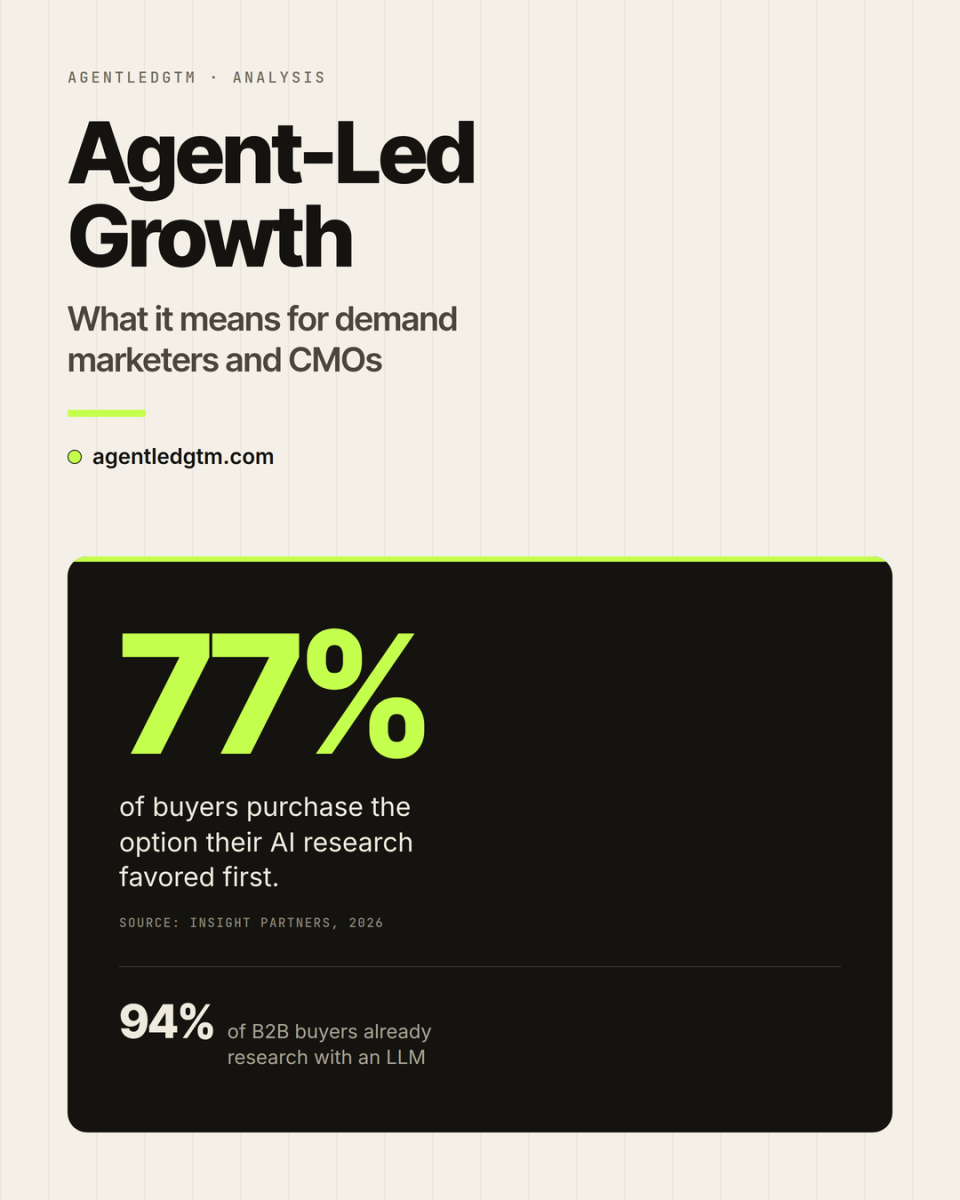
94% of business buyers now use large language models in their research. That one number explains why agent-led growth has two halves, and why both of them matter to you.
First, two plain definitions. A large language model, or LLM, is software that reads text and writes an answer. An agent is an LLM that can also act. An agent can search the web, open pages, run a test, fill in a form, and start a purchase.
Agents work for two parties in every deal. Insight Partners gives the two halves clear names.
- Supply-side agent-led growth. You run agents to sell. This makes your current funnel cheaper and faster.
- Demand-side agent-led growth. Your buyer runs agents to buy. This decides which vendors your buyer sees.
Each half needs different work from you. Select a half below to see the difference.
The two halves of agent-led growth
Select a half to see who runs the agent, what it changes, and what you build.
An agent works from a goal
A marketing automation rule runs the path that you wrote. An agent works toward a goal that you set. That single difference changes most of the habits your team built over the last ten years.
A rule runs one path. You define the trigger, the branch, and the message. An agent gets a goal and limits. It reads the current data, picks a step, checks the result, and picks the next step.
| Point of comparison | Traditional automation | An agent |
|---|---|---|
| What you give it | A fixed path | A goal and limits |
| How it decides | It follows the rules you wrote | It reads the data and chooses a step |
| How it improves | You edit the rules | It tests, learns, and adjusts |
| When it starts | A trigger fires | It watches and starts on its own |
| What it costs you | A license and setup time | A license, clean data, and review time |
| Biggest risk | The rule goes stale | It acts fast on bad data |
Read the last row again. Speed is the benefit and the risk. An agent with bad data is a fast way to be wrong many times.
Agents run loops
A loop is a cycle where the result of one round becomes the input of the next round. Growth teams have used loops since Reforge published “Growth Loops are the New Funnels” in 2018. Agents make loops the standard way to run go-to-market work.
Anthropic describes an agent as software that runs in a loop. It takes a step, reads the result from its tools, and decides the next step. Every agent job in this guide runs the same five-step loop. Select a step below to see it on a real job: an agent that qualifies inbound leads.
The five-step loop every agent runs
Select a step. The example follows one inbound lead through an agent that qualifies it.
Step 5 feeds step 1 ↻ the loop runs again
The loop structure follows Anthropic, “Building effective agents,” December 2024.
The demand side runs a loop too. Insight Partners calls the result a compounding default. The buyer’s agent picks a vendor. The setup works. The agent picks the same vendor next time, and recommends it to the next buyer. More buyers mean more public examples, which make the vendor easier to find. The loop feeds itself.
So the job of a go-to-market team changes shape. You design loops that run every day. A campaign runs once and stops. A loop keeps running and gets better with each round.
Decision speed is the number to fix first
Count the changes your team made last week. Do not count the ones you discussed, deferred, or put in a deck. Count only the changes that went live. Most teams find a number between two and five.
Two to five changes a week is a review pace. It is not a management pace. Call this number your decision speed: the count of decisions your team turns into live changes each week.
Setup speed and decision speed are the same problem. A motion that needs a quarter to build also needs a quarter to change. Fix the second number and you fix the first.
The problem is not measurement. Marketing mix models, geo holdout tests, and incrementality tests give growth teams better numbers than they had ten years ago. A marketing mix model estimates the return of each channel from historical spend. A geo holdout test turns off a channel in some regions and compares the result. The dashboards are full. The findings are sound. The actions are slow.
Name the gap and you can manage it. The insight-action gap is the time between the day your measurement produces a finding and the day your team acts on it. Listen for this sentence from your team: “The model showed us this last quarter. We changed it three months later.” That delay is your real cost.
Agent-led growth attacks this number directly. Agents move a team from a handful of changes a week to dozens. That is not a small productivity gain. It changes what your budget is.
Run your marketing budget like a portfolio. Treat every dollar as a position with a measured return. Cut the positions that fail. Rebalance when the proof arrives, not when the quarter ends.
The job that decision speed unlocksMost growth leads manage a budget like a project. They chase status across many tools. They justify last quarter’s spend after the fact. A portfolio manager works the other way. Each position earns its place with a measured return. The next dollar goes where it earns the most. You win a bigger budget next quarter because you proved the last one worked.
Two ways growth teams get stuck
Teams do not fail at agent-led growth for one reason. They fail for two opposite reasons. Check which one describes your team today.
- Correct but slow. Your measurement is rigorous. The output is a quarterly report. An analyst reads it, a strategist translates it, a meeting aligns on it, and an operator applies it eight weeks later. The finding was right. The market moved first.
- Fast but wrong. Your tools recommend budget moves every day, built on last-touch or multi-touch attribution. The recommendations arrive fast. The signal behind them is a correlation, not a cause. Nobody sees the problem until somebody runs a holdout test.
Agent-led growth resolves the trade-off. You keep the causal foundation. You add a daily loop that turns each finding into a live change. Accuracy and speed stop competing.
Run the loop every day: analyze, decide, plan, act, prove
Three decisions, planned and applied, before the first stand-up meeting. That is the shape of a morning under agent-led growth.
Figure 3 shows the loop inside one agent. This loop runs across your whole team, every day, on five steps: analyze, decide, plan, act, and prove. Select a step below to see the step and one example morning.
The daily loop your team runs
Select a step. The example follows one Tuesday morning at a growth-stage company.
Step 5 feeds step 1 ↻ the loop runs again tomorrow
An example morning. Your channels, your thresholds, and your times will differ.
The prove step is the one most teams skip. It is also the one that makes the loop compound. Each proved result updates the return curve that feeds tomorrow’s analysis. Your quarterly model refresh becomes a calibration event. It stops being the moment you decide.
Note the split of work in that example. The agents read, recommend, log, and apply. The person sets the limits, approves the moves above a threshold, and writes the strategy. One human decision took six minutes.
Three changes made this possible now
Agents could have run go-to-market decisions five years ago. Three things stopped them. All three are now gone.
- Measurement became causal. Apple released App Tracking Transparency in 2021. Platform-reported results stopped matching revenue for many advertisers. The change did not break attribution. It showed that attribution never proved cause. Teams moved to marketing mix models and holdout tests. An agent needs a number it can trust, and now that number exists.
- The Model Context Protocol removed the cost of connections. Anthropic published the Model Context Protocol, or MCP, in November 2024. MCP is an open standard that lets an AI system call tools in other platforms. Before MCP, each connection needed months of custom engineering. Now the connection is a setting. This is the single change that made a daily loop practical for a small team.
- The cost to run a model fell. A set of specialist agents that reads your live data every morning now costs less each month than one junior analyst. It also runs every morning, and not only when a person has time.
Follow the sequence. The bottleneck in go-to-market work moved from data, to model quality, to decision speed. Agent-led growth addresses the last one.
Your buyer already brought an agent
77% of buyers purchase the option their AI research favored first. Insight Partners reports that figure beside the 94% research number above.
Think about what those two numbers do together. The buyer’s agent reads your public pages, compares you to three competitors, and forms a favorite. Your seller meets the buyer after that.
Gartner projects that 33% of enterprise software applications will include agentic AI by 2028, up from under 1% in 2024. Gartner also projects that agents will resolve 80% of common customer service issues on their own by 2029. The share of the journey that a person sees keeps falling.
We cover the demand side in depth in a separate post for marketing leaders: Agent-Led Growth: What It Means for Demand Marketers and CMOs. The rest of this guide focuses on the work you control.
Point your first agents where the work repeats
Companies put over half of their generative AI budget into sales and marketing. Their best measured returns came from back-office work. That finding comes from the MIT NANDA report “The GenAI Divide,” published in August 2025.
The lesson for a go-to-market team is simple. The best first agent job is a task your team repeats every week, with text as the input, and a person who checks the output. The chart below plots 14 common agent jobs. The horizontal axis is setup effort. The vertical axis is payoff. Filter by team, then hover or tap a point for the detail.
Where to point your first agents
Fourteen common agent jobs, rated on setup effort and payoff. Start in the top left.
Effort and payoff run from 1 to 5. Your numbers will differ by team size and data quality.
Three patterns show up in the top left of that chart every time.
- The task repeats. Somebody does it more than 20 times a week.
- The input is text. Agents work best on documents, records, and messages.
- A person checks the output. You can see the mistake before a customer does.
Group your agents in four layers
One agent is a tool. Four layers make a system. A single agent saves an hour a day. A stack of agents changes the pace of your whole team.
Before you build, read this warning. A decision layer with no operating layer gives you a faster report. An operating layer with no decision layer applies changes you cannot defend. Build the layers together, or build them in the order below.
Select a layer to see what it holds, what it does, and what breaks without it.
The four layers of an agent stack
Select a layer. Each layer works alone. The system works when all four run together.
Build the data layer first if your records are dirty. Build the decision layer first if your numbers are correlational.
Small teams can start with two layers. Connect your data, then add one decision agent and one operating agent for the same job. Add the memory layer as soon as two agents need the same context.
Five things you need before an agent earns its keep
Gartner predicts that over 40% of agentic AI projects will be canceled by the end of 2027. Gartner names three causes: rising costs, unclear business value, and weak risk controls. Each of the five items below removes one of those causes.
- One clear job. Name the task, the input, and the output. “Qualify inbound leads and book a meeting” works. “Help marketing” gives the agent nothing to aim at.
- Clean data the agent can reach. Connect the customer relationship management system, the product data, and the website. Fix duplicate records first.
- Written limits. Tell the agent what it must never do. Common limits cover discounts, legal claims, brand voice, and customer data.
- One measure and one owner. Pick a single number before you start. Give one person the job of reading it every week.
- A stop button. Any person on the team must be able to pause the agent in one click.
Start with one agent, one channel, and one number. A small pilot that you can measure beats a platform that nobody trusts.
Advice for the first 30 daysThree questions that tell you if you are ready
An agent on a weak foundation makes the wrong call faster. Answer these three questions before you connect anything.
1. Is your measurement causal?
Name one budget decision that your measurement changed. The decision must be one that gut feel did not already give you. “We know paid search works” does not count. “Channel X is over-funded by 30%, and this holdout test proves it” does count. If you cannot name one, your numbers are correlational. Agents will apply those numbers faster.
2. Does your team feel the gap between insight and action?
Ask your team for one example of a finding that waited. If they name one at once, you have an insight-action gap. Your measurement works. Your decision speed does not. Agent-led growth closes that exact gap.
3. Does your leadership want leverage before headcount?
Agent-led growth changes the shape of the team. Your finance lead and your marketing lead must agree on one point first. The next large gain comes from a faster decision loop, and not from two more analysts. Get that agreement in writing before you start.
Make yourself easy for the buyer’s agent to choose
An agent reads what is public. It reaches the vendor with open documentation and a visible price first. Every open path on your site keeps the agent with you, and every gate sends it to the next vendor on the list.
| Test | The question an agent asks | Your first move |
|---|---|---|
| Findable | Does this vendor appear when I search the problem? | Write pages that answer the buyer’s problem, with your feature list below it. |
| Evaluable | Can I judge this product on my own? | Publish full documentation and plain-text prices. |
| Actionable | Can I start a trial or buy on my own? | Open a free tier and remove the approval step. |
Run the honest test this week. Point an agent at your own website and ask it to pick a vendor for your category. Then watch where it stops.
What moves to agents, and what stays with people
Agent-led growth does not shrink the growth team’s job. It changes the job’s character. The team stops compiling reports. It starts deploying budget against proof.
| Work that moves to agents | Work that stays with people |
|---|---|
| Daily data pulls from every platform | Strategy and priority |
| Weekly report formatting | Goal setting and budget thresholds |
| Budget pace monitoring | Written limits on what agents may change |
| Creative fatigue detection | Creative direction and the brief |
| Competitor spend monitoring | Approval of large moves |
| Test status tracking | Test design for new questions |
| Routine bid and budget changes | Communication with executives and the board |
| Account research and first-draft messages | The conversations that decide a deal |
Look at the left column. Most of that work fills an analyst’s week. It produces little strategic value. Move it, and a small team covers the ground of a much larger one.
The role name changes with the work. A growth lead who compiles reports is a project manager. A growth lead who deploys budget against proof is a portfolio manager. Creative direction stays with people. Agents rotate, retire, and fund the creative you already approved.
A 90-day plan to capture the value
You need 90 days and one owner per track to start. Select your role below for a plan you can start on Monday.
Your first 90 days
Select a role. Each plan covers both halves of agent-led growth.
A starting plan. Adjust the pace to your team size and your data quality.
Change what you count
Your dashboard needs six new measures for the part of the journey that agents run. Add them beside the measures you keep.
| New measure | What it tells you | How to get it |
|---|---|---|
| Decision speed | How many findings your team turns into live changes each week | Count the changes that went live last week. Do not count the ones you discussed. |
| Agent mention rate | How often an AI answer names you in your category | Ask the same 20 buyer questions across the major assistants each month. |
| Token-to-value | How much work an agent needs to go from a problem to a working setup with you | Run the setup with an agent and record the token count. Lower is better. |
| First-choice share | How often the buyer’s AI research named you first | Add one question to your win and loss form. |
| Gate count | How many walls an agent meets on your site | Count forms, logins, and hidden prices on the path to a trial. |
| Agent task accuracy | How often your own agent output passes review | Review a sample of 20 outputs each week and score them. |
Four rules from the programs that survive
Purchased agent tools succeed about 67% of the time. Internal builds succeed about half as often. That comparison comes from the MIT NANDA report. Two research groups, MIT NANDA and Gartner, studied why agent programs stop. Their findings give you four rules.
- Pick the job and the number before the tool. Gartner lists unclear business value as a top reason projects get canceled. A named job with a single measure gives the project a value to show.
- Buy the first agent, and build later. MIT found that purchased tools succeed about twice as often as internal builds. Save your engineering time for public documentation and agent-ready conversion paths.
- Keep a review step. Gartner lists weak risk controls as a top cause of cancellation. A weekly review of 20 outputs keeps the agent inside its limits and keeps the team’s trust.
- Keep your sellers, and change their job. Insight Partners finds that buyers now arrive later, with a favorite already formed. Each human conversation decides more than it used to.
The window is open now
Agents build habits the way people build habits. An agent that finds your product reliable picks it again, and it recommends it to the next buyer. That advantage grows on its own.
The developer tools market picked its defaults in under 18 months. Most other categories are still open. Sales software, human resources software, and vertical software are all still open.
Start with three moves. Count the changes your team applied last week, and write the number down. Launch one agent on one repeated job this month. Open your documentation this quarter. Then measure whether an agent can find you, judge you, and buy from you.
Common questions
What is agent-led growth?
Agent-led growth is a go-to-market model in which AI agents do part of the buying and selling work. On the supply side, your company runs agents that research, write, qualify, decide, and apply changes. On the demand side, your buyers run agents that find, test, compare, and buy. Both halves need work from you.
Why is agent-led growth a new go-to-market motion?
Teams run many go-to-market motions at once. A motion counts as a new one when it removes a task that needed human attention. Sales-led growth removed the limit of one person’s memory of a relationship. Product-led growth removed the gate in front of the product. Agent-led growth removes the slow manual work of building a motion that scales. Each shift changed the shape of the team.
How is agent-led growth different from product-led growth?
Product-led growth changes how buyers first get value. The product does the demonstration. Agent-led growth changes how your team decides and acts, and how buyers research and choose. The two work together. Product-led growth feeds the top of the funnel. Agent-led growth runs the decisions that fund it.
How is agent-led growth different from marketing automation?
Marketing automation runs a fixed path that a person writes. Agent-led growth gives an agent a goal and limits, and the agent picks its own steps. Agent-led growth also includes the agents your buyers use, which act for the buyer.
What is decision speed?
Decision speed is the number of findings your team turns into live changes each week. Count only the changes that went live. Most teams count between two and five. Agent-led growth moves that count to dozens.
What does it mean to run a marketing budget like a portfolio?
Treat every dollar as a position with a measured return. Cut a position when the proof says it fails. Move the next dollar to the position that earns the most. Rebalance when the proof arrives, and not when the quarter ends.
What is a loop in agent-led growth?
A loop is a cycle where the result of one round becomes the input of the next. An agent senses, decides, acts, checks, and learns, then starts again. Your team runs the same shape at a larger scale: analyze, decide, plan, act, and prove. A loop runs every day and improves with each round.
What does the Model Context Protocol do for agent-led growth?
The Model Context Protocol, or MCP, is an open standard that lets an AI system call tools in other platforms. Anthropic published it in November 2024. Before MCP, each connection to an ad platform, a model, or a customer relationship management system needed custom engineering. MCP turns that build into a setting, which is why a small team can now run a daily loop.
Do I need a marketing mix model before I start?
No. You can start supply-side agents on repeated text tasks with no model at all. You do need a causal measurement foundation before agents change budget. Start with one holdout test on your largest channel. Then add the model.
Which agent is the right first pick for a small team?
Pick a task that repeats more than 20 times a week and produces text. Account research before a call is the most common first win. Draft follow-up emails come second.
What does an agent-led growth team look like?
It is smaller than a traditional performance marketing team, and it covers more ground. A common setup has three people. One leader sets strategy and approves agent recommendations. One measurement owner runs the causal foundation and the test queue. One creative strategist writes the brief and reads the fatigue signals. The agent stack covers the analysis and the routine changes.
When do I need engineers?
The first agent connects to your existing tools with no code. You need engineering help for two later steps: public documentation and agent-ready conversion paths.
How do I keep an agent on brand?
Write the limits down before you launch. Give the agent your approved messages, your banned claims, and your tone rules. Then review a sample of the output every week.
How do I know whether an agent works?
Pick one number before you start, and record the value for the four weeks before launch. Common numbers are meetings booked, hours saved, reply rate, and ticket resolution time. Compare the same number after 30 days.
What happens to go-to-market jobs?
Agents take the repeated tasks: research, drafting, data entry, report formatting, and first-line answers. People keep the roles. They move to strategy, judgment, test design, and the conversations that decide a deal.
What does a founder do first?
Do three things this month. Remove the form in front of your key content. Name one owner for agent work. Then ask an agent to buy your product, and watch where it stops.
Sources. The supply-side and demand-side frame, the three tests, and the 94% and 77% figures: Neal Behrend, “Agent-led growth: The next GTM motion is already here,” Insight Partners, March 13, 2026. The 40% cancellation forecast, its three causes, and the 2028 software figure: Gartner press release, June 25, 2025. The 2029 customer service figure: Gartner press release, March 5, 2025. The budget split and the buy-versus-build rates: MIT NANDA, “The GenAI Divide: State of AI in Business 2025,” August 2025, as reported by Fortune. Growth loops: Brian Balfour, “Growth Loops are the New Funnels,” Reforge, 2018. The agent loop: Anthropic, “Building effective agents,” December 19, 2024. The Model Context Protocol: Anthropic, “Introducing the Model Context Protocol,” November 25, 2024. App Tracking Transparency: Apple developer documentation. Insight Partners discloses investments in OpenAI, Anthropic, StackBlitz, and 6sense. The decision-speed range, the ratings, the plans, and the measures are estimates for planning, not research findings.