
Agent-Led Growth: What It Means for Demand Marketers and CMOs

Agent-Led Growth
Content visibility to AI agents has never been as important as it is today
Buyers now send software to do their research. That software reads your documentation, tests your product, and picks a favorite. It does this before a seller ever answers the phone. This post explains what changes, and gives you a plan for this quarter.
Your next buyer may never read your website
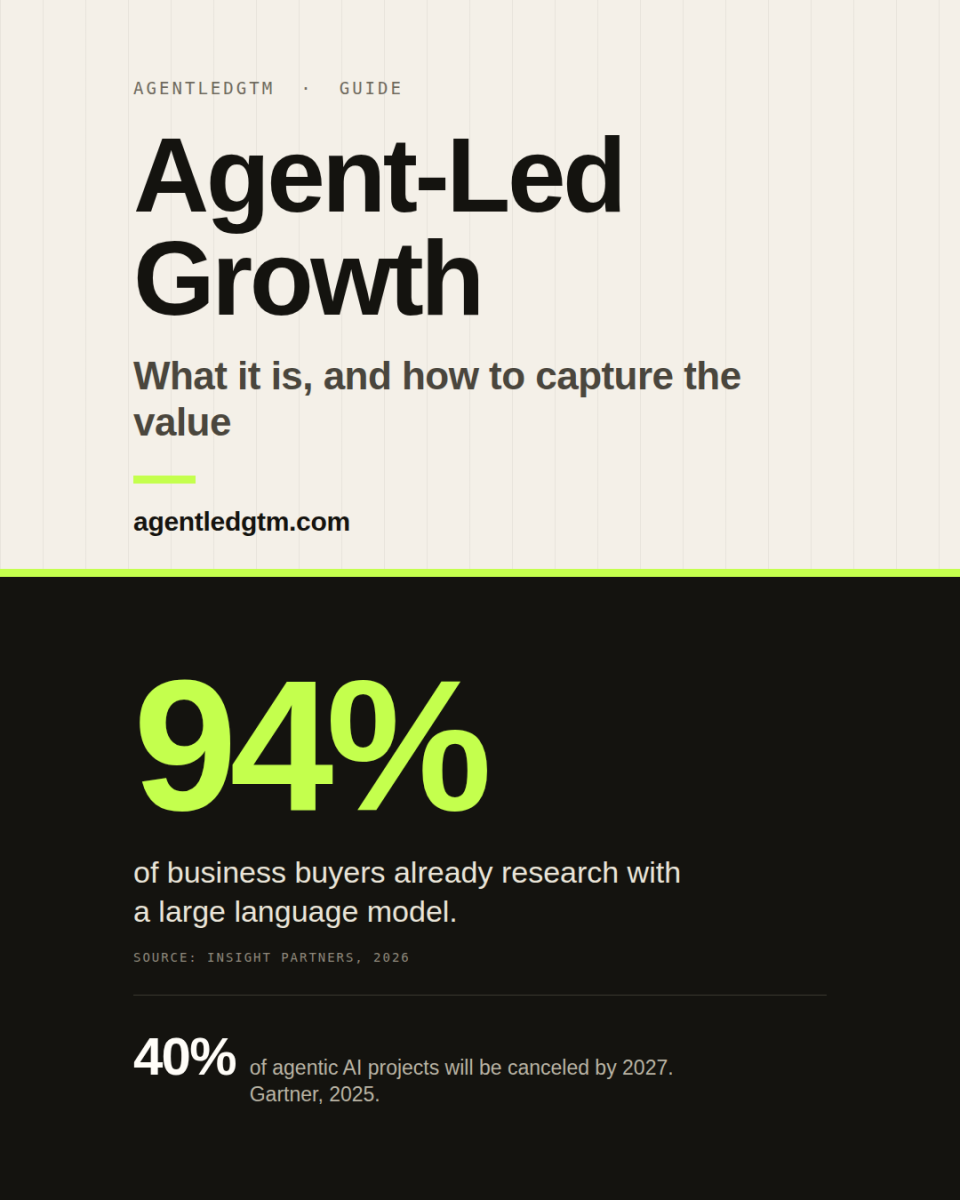
94% of business buyers already use large language models in their research. That single number should change your media plan.
A large language model, or LLM, is software that reads text and answers questions. An agent is an LLM that can also act. An agent can search, open pages, run tests, and start a purchase.
Your homepage still exists. The first reader changed. The agent reads your documentation, your pricing page, and your interface for developers. Then it hands your buyer a short list of two or three vendors.
You cannot win a short list that you never appear on.
One name, two very different ideas
Ask ChatGPT to define agent-led growth. You will get half of the answer.
Supply-side agent-led growth is the half you get. Your company uses agents to sell. Agents write outbound email. Agents draft content. Agents clean the pipeline. This work is real, and it saves money. It makes your current funnel cheaper.
Demand-side agent-led growth is the half that changes the market. Your buyer uses agents to buy. The agent compares vendors, builds a feature table, tests your product, and recommends a winner.
Supply-side work makes your funnel cheaper. Demand-side work decides who owns the funnel.
Our reading of the distinction Insight Partners drawsMost marketing teams budget for the first idea. The second idea is the one that moves market share.
Every growth motion starts with new infrastructure
Sales-led growth did not scale because sellers got better. It scaled because Salesforce gave sellers one system of record. Product-led growth needed product analytics. Account-based work needed intent data. Each motion waited for a layer of software to arrive first.
Agent-led growth followed the same order. The software layer arrived in February 2026. Click through the four eras below.
Four go-to-market motions, and the infrastructure that unlocked each one
Select an era to see what changed, who moved first, and what marketing had to build.
Eras, infrastructure, and named early movers follow the Insight Partners analysis. The “what marketing had to build” line is our addition.
Developer tools show you the end state
Resend went from zero to 400,000 users after a 2023 launch. Very little of that came from a sales team. Agents chose Resend, again and again.
Resend sells transactional email. When a developer asks Claude Code to add email to a project, Claude Code picks Resend in 63% of tests. SendGrid is a much larger competitor. Claude Code picks SendGrid in 7% of tests.
Supabase tells the same story at a larger scale. Supabase became the default backend for the tools that write code from a prompt. It grew from 1 million developers to 4.5 million developers in under 12 months. Its valuation moved from $765 million in September 2024 to $5 billion in October 2025.
“Our sign-up rate doubled in three months because of Bolt, Lovable, Cursor.”
Supabase CEO, quoted by Insight PartnersWhat agent selection is worth
Switch between the two published proof points. Hover or tap a bar for the exact number.
Look at what these two companies share. None of it is a campaign.
- Deep documentation that software can read without help.
- A free tier, so no buyer needs budget approval to start.
- A clean and predictable interface, so the agent makes fewer guesses.
- Heavy presence in model training data, through open-source work and public writing.
Three of those four items sit with engineering and technical writing. That is the first hard lesson for a marketing leader. In this motion, part of your growth budget buys engineering time.
The whole funnel moves, not just discovery
77% of buyers purchase the option their AI research favored first. Most of the industry conversation stops at discovery. Discovery is the smallest part of this shift.
Here is what happens at each stage.
- Discovery. The agent decides which vendors the buyer sees at all.
- Evaluation. The agent reads your documentation and tests your product. This often happens before any sales call.
- Decision. Your seller no longer creates the preference. Your seller confirms it or fights it.
- Purchase. Agent-started transactions are already live for consumers. Business use is close behind.
Speed is the part people miss. A developer in Claude Code can move from a problem to a working integration in under five minutes. Insight Partners recorded one run through the full funnel in under four minutes.
The funnel did not disappear. It got faster, and it moved earlier.
Move the sliders below to see this in your own numbers.
How many of your deals arrive with a favorite already picked?
Set your pipeline size and the share of buyers who research with an agent. The model then applies the published 77% rate.
Model, not a forecast. It applies two published rates to your inputs: buyers who research with an agent, and the 77% who buy their agent-informed first choice. It assumes those rates hold in your category.
The infrastructure arrived on February 12
Google and Microsoft published WebMCP on February 12, 2026. It shipped in Chrome 146. It is the piece that was missing.
WebMCP is short for Web Model Context Protocol. It lets a website describe its own forms to an agent. You add a few HTML attributes to a form. You give the form a name and a short description. Chrome then turns that form into a tool the agent can call. You do not have to change your backend.
Before WebMCP, agents worked the way a person works. They took a screenshot, guessed where to click, and tried again. Research cited by Insight Partners found that two-thirds of the computing spent on AI-to-web interaction went to that guesswork.
WebMCP joins three other layers:
- Model Context Protocol (MCP) from Anthropic connects agents to tools and data.
- Agent-to-Agent (A2A) from Google lets agents coordinate with each other.
- Payment protocols from Google and Stripe let an agent complete a purchase.
Here is our take. WebMCP is the first protocol decision that belongs to marketing. Your pricing page, your trial signup, and your demo request are now conversion paths that an agent can operate. Somebody has to decide which ones to open. That decision is a demand generation decision, not an engineering one.
Three tests: findable, evaluable, actionable
Y Combinator joked about a new motto: build something agents want. Selling asks for more than that. Insight Partners frames the work as three properties. We agree with the frame, so we will use it.
Findable
Generative Engine Optimization, or GEO, is work that makes an AI answer name your company. Answer Engine Optimization, or AEO, does the same for answer engines. Both are table stakes now. The real question is the split between classic search work and this new work. Review that split every quarter.
Evaluable
Agents read documentation. Agents do not read pitch decks. Supabase and Resend both spent more on developer documentation than on marketing copy.
Ask your sellers one question this week. Which questions come up in every demo that your public pages do not answer? Every one of those gaps costs an agent extra work. The design target has a name: token-to-value. It is the number of tokens an agent needs to go from a problem to a working setup. Lower is better. Audit your documentation against that target, not against your version numbers.
Actionable
Work with engineering to describe your key conversion paths for WebMCP. Start with the demo request, the trial signup, and the pricing page. A free tier or usage-based pricing removes the budget approval step. That step is where most agent-started deals stop.
Then run the honest test. Point an advanced agent at your own product and ask it to buy. Watch where it stops. The gaps show up fast.
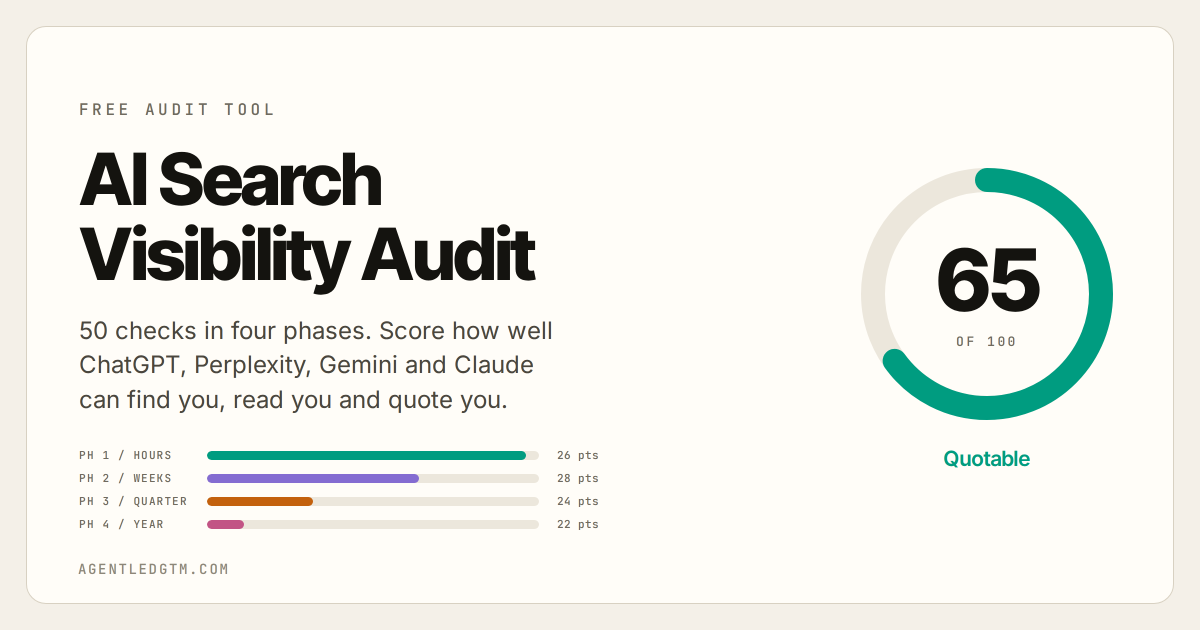
Score yourself below.
Agent-readiness scorecard
Check every item that is true of your company today. Nothing is stored or sent anywhere.
The three properties come from the Insight Partners framework. The nine checks are ours.
What we would change in a demand plan this quarter
None of this replaces good marketers and sellers. It sits on top of them. Agents reward consistency between your marketing, your documentation, and your sellers. So start small, and start where the gap is widest.
Here are seven moves. Each one is small enough to finish in a quarter.
- Move 10% of paid budget to documentation. Fund a technical writer. Documentation is now demand generation.
- Remove the form in front of your key content. An agent cannot fill in a gate. Every gate is a wall.
- Publish your prices. A hidden price forces the agent to guess or to skip you.
- Add one field to your win and loss form. Ask which vendor the buyer’s AI research named first.
- Track token-to-value like you track page speed. Test it monthly. Report it to the board.
- Rewrite the handoff to sales. Calls now arrive later and better informed. Coach for confirmation, not for discovery.
- Ask an agent to buy your product. Record the session. Show it to your executive team.
Two warnings before you start. Do not rebuild your funnel around agents this year. Do not cut your sales team. Buyers arrive further down the funnel now, and they value their time more. That raises the stakes of every human conversation, so protect it.
Defaults compound
Agents build trust the way people build trust. An agent that finds your product reliable will pick it again. Then it recommends it to the next buyer. That is a moat, and it grows on its own.
The developer market picked its defaults in under 18 months. Customer relationship management, human resources, marketing automation, and vertical software have not picked theirs yet. That is the open window.
The question is not whether agents reshape business software distribution. The question is which category goes first, and whether today’s leader in that category earns the default or loses it.
Common questions
What is agent-led growth?
Agent-led growth is a go-to-market motion in which AI agents act for the buyer. The agent finds vendors, reads documentation, tests the product, compares options, and can complete the purchase. The buyer reviews a short list instead of doing the research.
What is the difference between supply-side and demand-side agent-led growth?
Supply-side agent-led growth is your company using agents to sell. It makes your current funnel cheaper. Demand-side agent-led growth is your buyer using agents to buy. It changes who controls the funnel. Most teams budget for the first and ignore the second.
What is WebMCP?
WebMCP is the Web Model Context Protocol. Google and Microsoft published it as an open standard on February 12, 2026, and it shipped in Chrome 146. You add a few HTML attributes to a form to give it a name and a description. Chrome then turns the form into a tool an AI agent can call. No backend change is required.
How do AI agents choose which vendor to recommend?
Agents favor vendors that are cheap to evaluate. Four things drive the choice: public documentation that software can read, a free tier that removes budget approval, a clean and predictable interface, and a strong presence in model training data. Claude Code picks Resend for email in 63% of tests and SendGrid in 7%.
What is token-to-value?
Token-to-value is the number of tokens an AI agent needs to go from a stated problem to a working setup with your product. Lower is better. Teams that win at agent-led growth audit their documentation against this target instead of only keeping version numbers current.
What should a CMO do first about agent-led growth?
Start with three moves that take one quarter. Publish your prices in plain text. Remove the form in front of the content an agent must read, because an agent cannot fill in a gate. Then point an advanced agent at your own product, ask it to buy, and record where it stops.
Does agent-led growth replace sales teams?
No. It changes the seller’s job. Buyers arrive later in the funnel with a preference already formed, so the seller confirms that preference or works to reverse it. The stakes of each human conversation go up, not down.
Source for all data in this post: Neal Behrend, “Agent-led growth: The next GTM motion is already here,” Insight Partners, March 13, 2026. The 94%, 77%, and two-thirds figures are outside research cited in that article. Analysis and recommendations are ours.

[…] cover the demand side in depth in a separate post for marketing leaders: Agent-Led Growth: What It Means for Demand Marketers and CMOs. The rest of this guide focuses on the work you […]