Agent-Led Growth: What it means for demand marketers and CMOs

AI agents now pick the short list for business buyers
Business buyers now send AI agents to do their vendor research. The agent reads your documentation, tests your product, and picks a favorite. This happens before a seller talks to the buyer. This post shows what changes for demand marketers and chief marketing officers (CMOs). It also gives a plan for this quarter.
AI agents now research vendors for your buyers
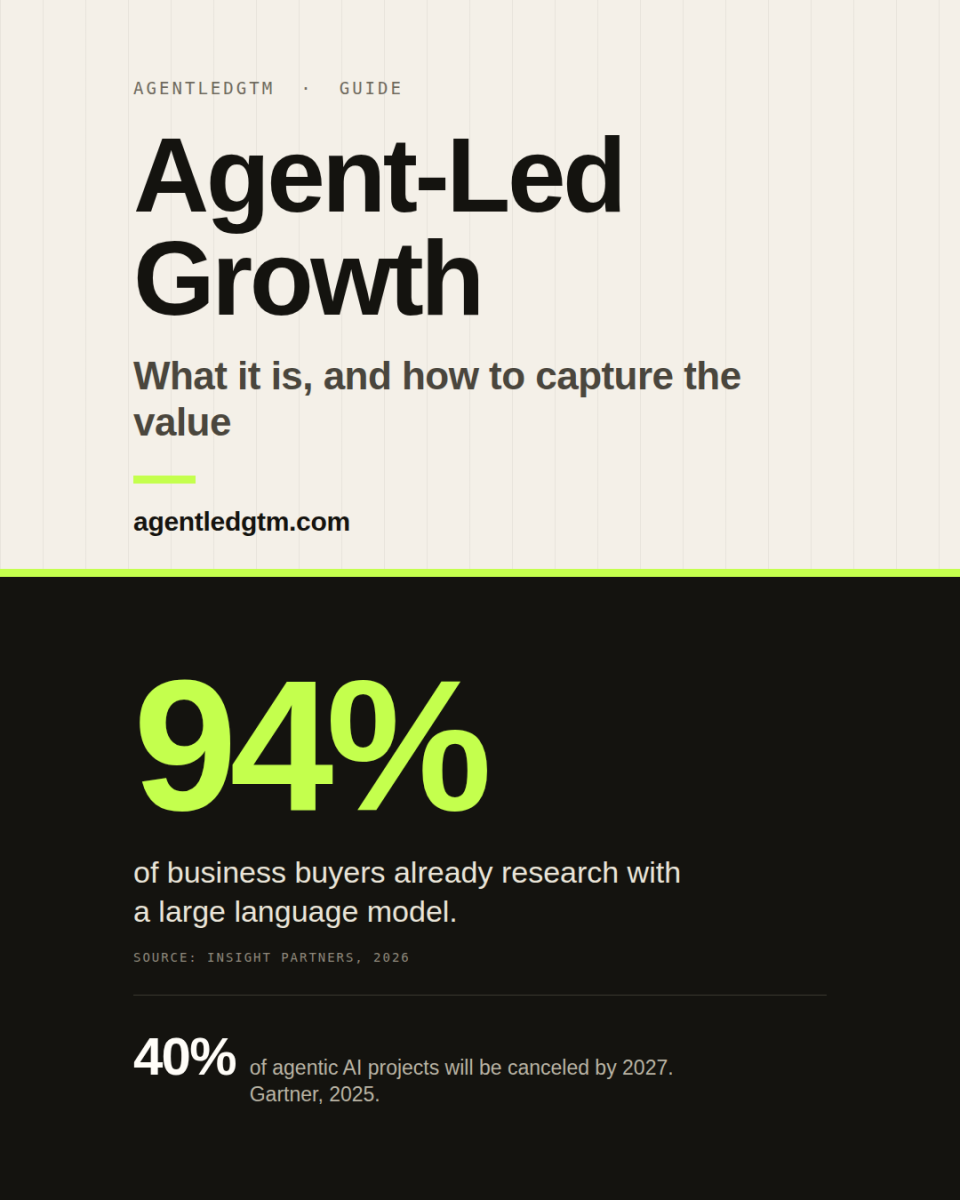
94% of business buyers already use large language models in their research. So the first reader of your website is often software, not a person.
A large language model (LLM) is software that reads text and answers questions. An AI agent is an LLM that can also act. In this post, “agent” always means an AI agent. An agent can search the web, open pages, run tests, and start a purchase.
The agent reads your documentation, your pricing page, and your interface for developers. Then it gives your buyer a short list of two or three vendors. If the agent leaves you off that short list, the buyer never sees you.
Supply-side and demand-side agent-led growth
Ask ChatGPT to define agent-led growth. It usually describes only one of the two ideas that share this name.
Supply-side agent-led growth means that your company uses agents to sell. Agents write outbound email, draft content, and clean pipeline data. This work saves money. It makes your current funnel cheaper to run.
Demand-side agent-led growth means that your buyer uses agents to buy. The agent compares vendors, builds a feature table, tests your product, and recommends one vendor.
Insight Partners states the difference clearly. Supply-side work improves the cost of your funnel. Demand-side work changes who owns the funnel. Most marketing teams budget only for the supply side. The demand side decides which vendors buyers see, so it decides market share.
Each growth motion started with new software
Salesforce made sales-led growth scale. Sellers did not suddenly get better. A customer relationship management (CRM) system gave them one record of every account.
Product-led growth needed product analytics. Account-based experience needed intent data. Each motion started only after a new layer of software arrived.
Agent-led growth follows the same pattern. Its software layer arrived in February 2026. Select each motion below to compare the four.
Four go-to-market motions and the software that started each one
Select a motion to see its software, what changed, its early movers, and the job of marketing.
The motions, their software, and the early movers come from the Insight Partners article.
Two developer tools grew because agents chose them
Resend grew from zero to 400,000 users after its 2023 launch. Insight Partners links this growth to agent selection, not to a sales team.
Resend sells transactional email. A developer can tell Claude Code to add email to a project. In tests, Claude Code picks Resend 63% of the time. It picks SendGrid, a much larger competitor, 7% of the time.
Supabase shows the same pattern at a larger scale. It became the default backend for many tools that write code from a prompt. Its developer count grew from 1 million to 4.5 million in under 12 months. Its valuation went from $765 million in September 2024 to $5 billion in October 2025.
“Our sign-up rate doubled in three months because of Bolt, Lovable, Cursor.”
Supabase CEO, as quoted by Insight Partners
Agent selection in numbers
Select a tab to see the published figures for Resend and Supabase.
Insight Partners names four traits that the two vendors share:
- Full documentation that an agent can read without help.
- A free tier, so a buyer can start with no budget approval.
- A clean and predictable interface, so the agent makes fewer guesses.
- A large presence in model training data, from open-source work and public writing.
Engineers and technical writers own three of these four traits. So in this motion, part of the growth budget must pay for engineering time.
Agents change every stage of the funnel
77% of buyers purchase the option that their AI research favored first. Most talk about AI and marketing covers only discovery. But discovery is only the top of the funnel.
The agent changes each stage:
- Discovery. The agent decides which vendors the buyer sees.
- Evaluation. The agent reads your documentation and tests your product. Often, this happens before any sales call.
- Decision. The buyer already has a preference when the seller arrives. The seller confirms that preference or works to change it.
- Purchase. Agent-started purchases already work for consumers, for example in ChatGPT. Insight Partners expects business purchases to follow soon.
The funnel is also much faster. With Claude Code, a developer can go from a problem to a working integration in under five minutes. Insight Partners recorded one developer who went through the full funnel in under four minutes.
Use the sliders below to apply these rates to your own pipeline.
How many of your deals start with a favorite already picked?
Set the number of deals and the percent of buyers who research with an agent. The model then applies the published 77% rate.
This is a model, not a forecast. It applies two published rates to your inputs. The first rate is the percent of buyers who research with an agent. The second is the 77% who buy the first choice of their AI research. The model assumes that both rates apply in your category.
WebMCP lets an agent use the forms on your website
Google and Microsoft published WebMCP as an open standard on February 12, 2026. It shipped in Chrome 146.
WebMCP means Web Model Context Protocol. It lets a website describe its own forms to an agent. You add a few HTML attributes to a form. HTML is the code that builds a web page. The attributes give the form a tool name and a short description. Chrome then turns the form into a tool that an agent can use. You do not change your backend.
Before WebMCP, an agent used a website as a person does. It took a screenshot, guessed where to click, and tried again. Research that Insight Partners cites found that two-thirds of the computing that AI used on websites went to this guesswork.
WebMCP adds a fourth layer to three protocols that agents already use:
- Model Context Protocol (MCP) from Anthropic connects agents to tools and data.
- Agent-to-Agent (A2A) from Google lets agents work with other agents.
- Payment protocols from Google and Stripe let an agent complete a purchase.
WebMCP is the first of these layers that marketing must help decide. Your pricing page, trial signup, and demo request become paths that an agent can use. Someone must choose which paths to open to agents. That is a demand generation decision, so marketing must make it together with engineering.
Three tests: findable, evaluable, actionable
An agent must find your product, judge it, and act on it. Insight Partners calls these three properties findable, evaluable, and actionable. Y Combinator joked that its new motto should be to build something agents want. Insight Partners suggests a better motto for sellers: sell something that agents can buy.
Findable
Generative engine optimization (GEO) is work that makes AI answers name your company. Answer engine optimization (AEO) is work that puts your company in the direct answers of search engines. Both are now basic requirements. Review your budget split between classic search work and GEO every quarter.
Evaluable
Agents read documentation. They do not read pitch decks. Supabase and Resend both put more money into developer documentation than into marketing.
Ask your sellers this question: which questions come up in every demo that your public pages do not answer? Each missing answer gives an agent more work.
Insight Partners names a target for this work: token-to-value. A token is a small piece of text that an AI model reads. Token-to-value is the number of tokens that an agent needs to go from a problem to a working setup. A lower number is better. Check your documentation against this target, not only against version numbers.
Actionable
Work with engineering to describe your key conversion paths for WebMCP. Start with the demo request, the trial signup, and the pricing page.
A free tier or usage-based pricing removes the budget approval step. An agent cannot get budget approval alone, so that step stops agent-started deals.
Then do a direct test. Tell an advanced agent to buy your product. Record each point where the agent stops. Those points are your gaps.
Use the scorecard below to score your company on the three tests.
Agent-readiness scorecard
Select each item that is true for your company today. This page does not store or send your answers.
The three tests come from the Insight Partners framework.
Seven changes to make in your demand plan this quarter
Each change below fits in one quarter. Agents reward vendors whose marketing, documentation, and sellers say the same thing. So these changes add to the work of your marketers and sellers. They do not replace it.
Before you start, read two warnings. Do not rebuild your whole funnel around agents this year. Do not cut your sales team. Buyers now arrive later in the funnel and value their time more, so each conversation with a seller matters more.
- Move 10% of your paid media budget to documentation. Use it to hire a technical writer. Documentation now brings in demand.
- Remove the form in front of key content. An agent cannot fill in a gated form, so it cannot read the content behind it.
- Publish your prices. If your price is hidden, the agent must guess it or skip your product.
- Add one field to your win and loss form. Ask which vendor the buyer’s AI research named first.
- Track token-to-value as you track page speed. Test it every month. Report it to the board.
- Change the handoff to sales. Buyers now arrive later in the funnel and know more. Train sellers to confirm a preference, not to discover a need.
- Tell an agent to buy your product. Record the session. Show the recording to your executive team.
Agents keep picking the vendors they trust
The developer market picked its default vendors in under 18 months. Agents build trust in a vendor the same way people do. If a product works well, the agent picks it again. Then the agent recommends it to the next buyer. Each repeat choice makes the default harder for a competitor to take.
Other software categories do not have agent defaults yet. These include CRM, human resources, marketing automation, and software for specific industries. In each category, the current leader can earn the default, or a competitor can take it first.
Common questions
What is agent-led growth?
Agent-led growth is a go-to-market motion in which AI agents act for the buyer. The agent finds vendors, reads documentation, tests products, and compares options. It can also complete the purchase. The buyer then reviews a short list and does not do the research.
What is the difference between supply-side and demand-side agent-led growth?
Supply-side agent-led growth means that your company uses agents to sell. It makes your current funnel cheaper to run. Demand-side agent-led growth means that your buyer uses agents to buy. It changes who controls the funnel. Most marketing teams budget only for the supply side.
What is WebMCP?
WebMCP is the Web Model Context Protocol. Google and Microsoft published it as an open standard on February 12, 2026. It shipped in Chrome 146. You add a few HTML attributes to a form to give it a name and a description. Chrome then turns the form into a tool that an AI agent can use. You do not change your backend.
How do AI agents choose which vendor to recommend?
Agents choose vendors that are easy to evaluate. Four traits help. The vendor has public documentation that an agent can read and a free tier with no budget approval. It also has a clean, predictable interface and a large presence in model training data. In tests, Claude Code picks Resend for email 63% of the time and SendGrid 7% of the time.
What is token-to-value?
Token-to-value is the number of tokens that an AI agent needs to go from a problem to a working setup with your product. A token is a small piece of text that an AI model reads. A lower number is better. Check your documentation against this target, not only against version numbers.
What should a CMO do first about agent-led growth?
Start with three changes that fit in one quarter. Publish your prices in plain text. Remove the form in front of the content that an agent must read, because an agent cannot fill in a gated form. Then tell an advanced agent to buy your product, and record each point where it stops.
Does agent-led growth replace sales teams?
No. It changes the job of the seller. Buyers arrive later in the funnel with a preference already in place. The seller confirms that preference or works to change it. Each conversation with a seller matters more than before.
Source for all data in this post: Neal Behrend, “Agent-led growth: The next GTM motion is already here,” Insight Partners, March 13, 2026.